

How Many CCTV Cameras Does a Shop in Ras Al Khaimah Need?
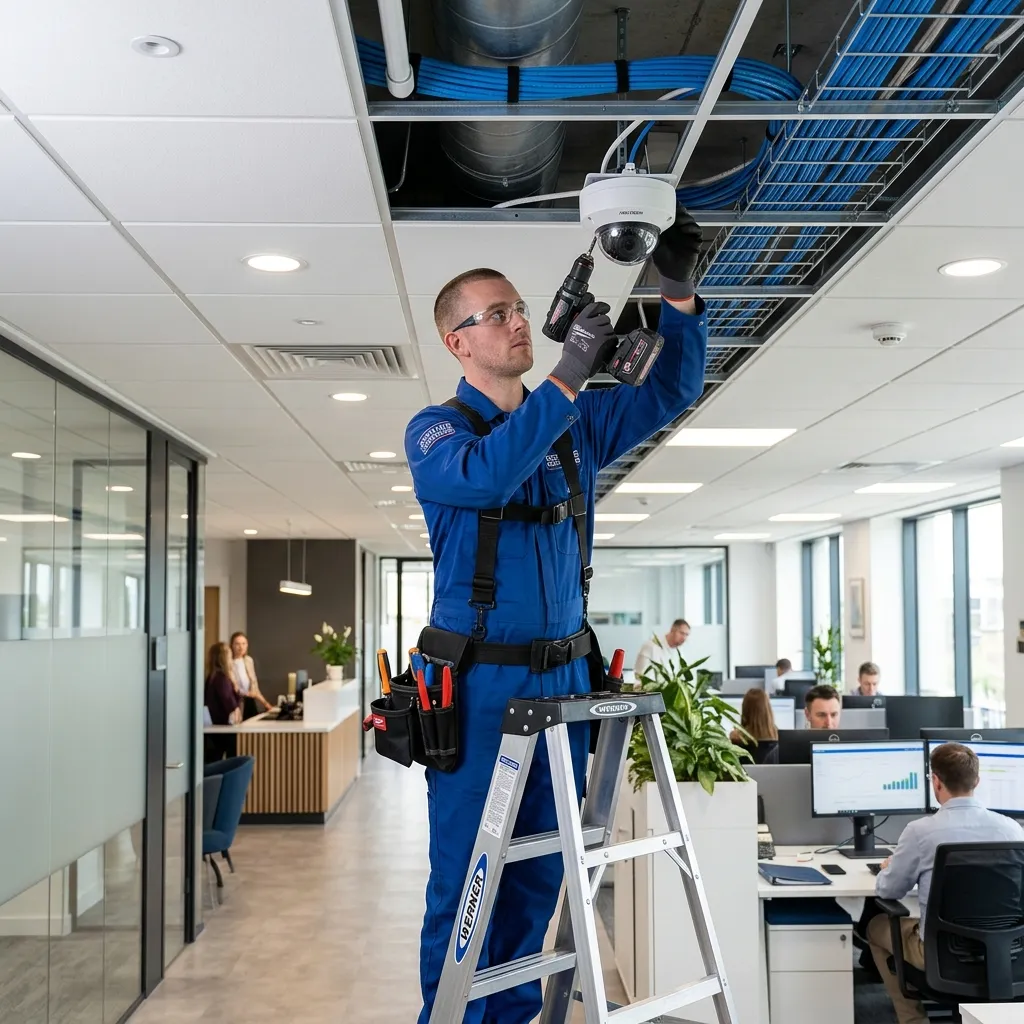
There is no fixed number in the regulation, and any installer who quotes you a camera count before seeing your premises is guessing.
Hemaya approval in Ras Al Khaimah is based on coverage, not on how many cameras you own. The requirement is that entrances, exits and emergency exits are covered, with images clear enough to identify a person, recorded continuously and retained for at least 90 days. Whether that takes four cameras or fourteen depends entirely on your layout.
In practice, a typical single-entrance retail unit in RAK works out at 4 to 6 cameras. A shop with a rear delivery door, a stockroom and two tills is usually 8.
The rule that catches most businesses out: recordings must be retained for at least 90 days. Not 7 days, not 30. Ninety. That single requirement drives more of the system cost — and more failed inspections — than the camera count does.
What the regulation actually says
CCTV for commercial premises in Ras Al Khaimah is governed by RAK Law No. 3 of 2015 on Technical Systems for Establishments Security, as amended by Law No. 6 of 2021. RAK Police set the technical specifications through the Hemaya system, and the General Resources Authority (GRA) supervises approvals and the list of approved providers.
The obligations that drive system design are:
- Cameras must cover entrances, exits and emergency exits
- Images must be clear enough to identify people — not merely show that someone was present
- The system must operate continuously and remain serviceable
- Recordings must be retained for at least 90 days without unauthorised alteration
- Access to footage must be restricted, and supplied to RAK Police on official request
- A notice must be displayed indicating that CCTV surveillance is operating
Nowhere does the law say "a shop needs six cameras." It says the coverage must be achieved. That is why two units of identical size can need different systems.
Typical camera counts in practice
These are what we usually end up specifying after a survey. They are not legal minimums — they are what it normally takes to achieve compliant coverage for that kind of premises.
| Premises | Typical cameras | |---|---| | Small shop, single entrance, one till | 4 – 6 | | Shop with a rear or delivery door | 6 – 8 | | Two tills plus a stockroom | 8 – 10 | | Showroom with multiple entrances | 10 – 16 | | Small office with reception | 4 – 6 | | Warehouse with yard and vehicle gate | 12 – 20+ | | Restaurant or cafe with kitchen access | 8 – 12 |
A larger unit does not automatically need more cameras. A long, narrow shop with one door may need fewer than a small square unit with three ways in.
Why counting cameras is the wrong place to start
Three things decide whether a system passes, and only one of them is the camera count.
Placement. A camera mounted high in a corner gives a nice overview and a useless image of anyone's face. Entrance cameras need to be at a height and angle that captures the face of someone walking in — which usually means lower and closer than people expect.
Resolution at distance. A 4K camera does not give you an identifiable face at thirty metres. What matters is pixel density at the point you actually care about, so a camera covering a wide forecourt and a camera covering a doorway are different specifications, not the same camera pointed differently.
Storage. This is where most quotes quietly fail. Ninety days of continuous recording from eight cameras at a usable resolution needs real storage capacity. Some installers meet the price by dropping the resolution, dropping the frame rate, or sizing the drive for thirty days and hoping nobody checks. All three produce a system that is compliant on paper and not compliant in reality.
What makes inspections fail
The most common problems we see when auditing an existing system:
- Storage sized for fewer than 90 days. Often because resolution or frame rate was raised after installation without resizing the disk.
- Backlit entrances. A glass shopfront with strong afternoon sun behind it turns everyone entering into a silhouette. Entrance cameras in RAK usually need wide dynamic range for this reason.
- Cameras drifted out of position. Vibration, cleaning staff and knocks move cameras over time. A camera that was compliant at handover may be pointing at the ceiling two years later.
- Dirty lenses. Especially near dusty roads, yards or construction. The system records perfectly and shows nothing identifiable.
- A failed hard drive nobody noticed. Recorders rarely announce this loudly. Businesses often discover it only when they need footage.
- The installed system does not match the approved design. Changing camera positions after approval, even for sensible practical reasons, is a common reason for failure.
Where cameras are not allowed
This one carries a penalty, so it is worth stating plainly. Cameras must not be installed where people reasonably expect privacy:
- Toilets and bathrooms
- Bedrooms
- Changing rooms
- Physiotherapy and treatment rooms
- Similar private areas
- Areas specifically designated for women
Breaching this carries a penalty. If an installer proposes a camera in any of these areas, that is a reason to stop and question the whole design.
What happens if your Hemaya certificate expires
This is the part most businesses underestimate, so it is worth being blunt about it.
An expired GRA certificate blocks your other government renewals. It is typically the first thing that stops in the system. Your trade licence and other related services cannot be renewed while the security certificate is lapsed. So a certificate you forgot about does not just sit there quietly — it holds up the rest of your business paperwork until it is resolved.
There is a grace period, and it is not the safety net people assume. A grace period of 30 days from the date of expiry generally applies, but it is subject to approval from the concerned departments — it is not automatic.
Here is the part that catches people out. Suppose your certificate expires, you apply for renewal 15 days later, and the department approves it 15 days after that. You are inside the 30-day window the whole time. A penalty is still imposed. The grace period gives you time to complete the process; it does not erase the fact that the certificate lapsed.
So the only safe approach is to renew before expiry. Not on the expiry date, and certainly not inside the grace period.
That matters to your installer as well as to you. Once the certificate has lapsed, the renewal is no longer a scheduling matter — it becomes a race against departmental timelines that neither of us controls. Starting early is the only part either side can actually influence.
Practically:
- Note the expiry date the day you receive the certificate
- Start the renewal conversation at least a month before it expires
- Have the system audited before you submit, not after — a failed inspection during renewal costs far more time than fixing it in advance
- Keep the certificate, maintenance records, camera schedule and authorised-user list together and current
What it costs
As a guide, a basic 4-camera system for a small shop in Ras Al Khaimah starts from AED 1,500–2,500. A full GRA-approved 8–16 camera system for a warehouse or hotel ranges from AED 4,000 to AED 12,000+.
The variables that move the price are camera count, resolution, and the storage needed to hold 90 days at that resolution. A quote that is dramatically cheaper than others is usually cheaper on storage.
Before you buy anything
Specifications vary by premises category — a shop, a warehouse, a residential building, a hotel, a school and a factory are not treated identically. Confirm your specific category with GRA before purchasing equipment, on +971 7 235 7779 or gra@gra.rak.ae.
And ask any installer to show you their current GRA/Hemaya provider certificate before awarding the job. Not a previous one — a valid one. You can verify it with GRA directly.
How RADON approaches it
We survey the premises first and count what needs covering, not what we would like to sell. You get a camera layout, a storage calculation sized to the required retention period, and an itemised quote before anything is ordered. Site surveys are free.
RADON COMPUTER is a GRA-approved integrator, listed among the top 10 approved integrators on the official GRA Hemaya portal.
If you have a licence renewal coming up, start earlier than you think you need to. Installation is usually a single day; the approval and inspection schedule is set by the authority, not by us.