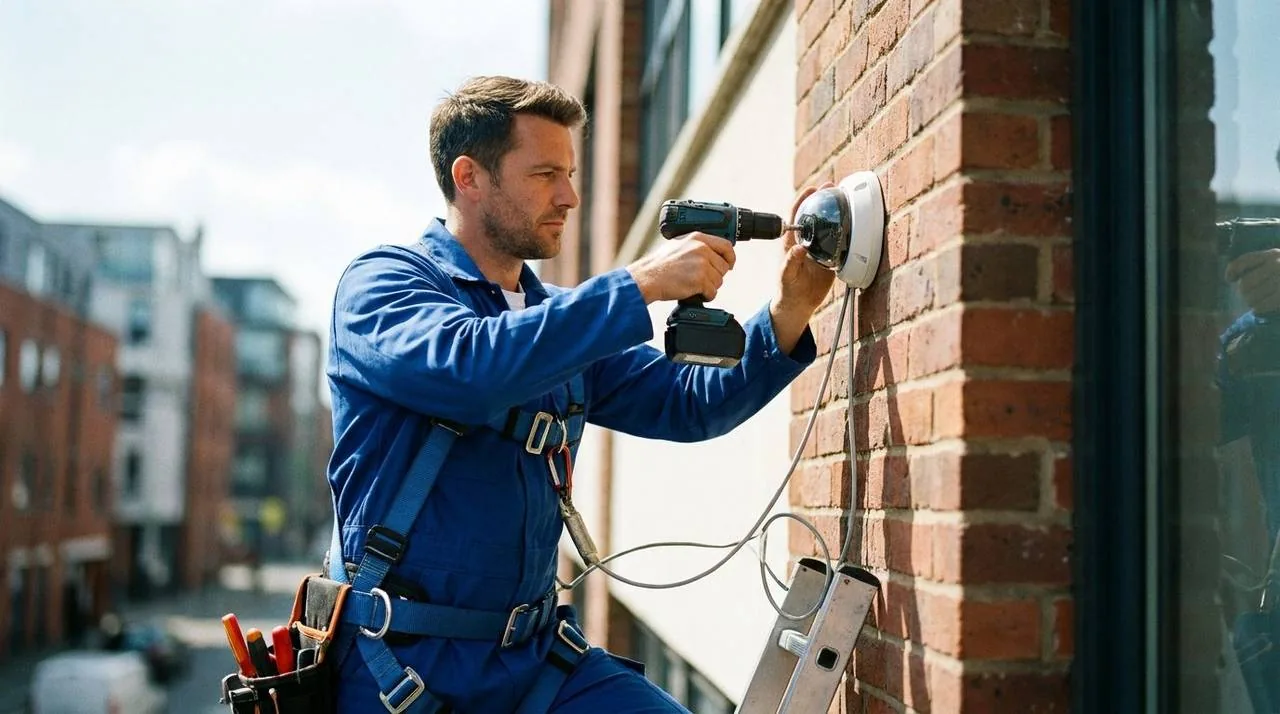
Sites under construction in Ras Al Khaimah are required to have CCTV coverage under the RAK Police Hemaya system, and the responsibility sits with the contractor. Cameras are needed from the beginning of works and throughout, not at handover. RADON is a GRA-approved integrator and installs solar-powered and 4G systems for sites with no mains electricity.
As applied by RAK Police and the General Resources Authority through the Hemaya system, construction sites in Ras Al Khaimah need CCTV covering all areas of the site — including the material store and the active work areas — running from the start of construction and for the duration of the works. Where the site has no mains electricity, solar-powered cameras are used. The system must provide mobile viewing and must record in line with GRA requirements. The obligation falls on the contractor, not the landowner. Specifications and enforcement can change, so confirm the current requirement for your project with GRA on +971 7 235 7779 before mobilising.
Who it is for
Who needs this service
Main contractors responsible for site compliance
Developers and project owners appointing contractors
Villa and building projects from groundworks onwards
Infrastructure, industrial and fit-out projects
Sites with no mains power or broadband connection
Scope
What is included, and what is not
Included
Site survey and camera layout covering the store, work areas and access points
Solar-powered cameras with battery backup where there is no mains supply
4G connectivity via SIM where there is no broadband
Mobile viewing so the contractor and project manager can check the site remotely
Recording configured to GRA requirements
Redeployment as the site progresses and the layout changes
Documentation for inspection
Transition to the permanent building system at completion
Not included
Provision of mains electricity to the site
SIM data subscriptions, which are contracted with du or etisalat
Government fees payable directly to GRA or RAK Police
Civil works, fencing, poles and foundations for mounting
Site security personnel
How it works
Our process
1
Survey before mobilisation
We visit the plot, agree coverage for the store, work areas and entrances, and confirm whether mains power exists.
2
Design and quote
Solar or mains, 4G or fixed line, camera positions and recording — quoted in full before anything is ordered.
3
Submission and install
We submit through the GRA Hemaya process and install so the site is covered from the start of works.
4
Mobile access
Contractor and project manager get live viewing and playback on their phones.
5
Redeploy as the build moves
The site changes shape. We reposition cameras so coverage stays valid rather than pointing at finished work.
6
Handover to the permanent system
When the building is complete and becomes an occupied premises, it needs its own Hemaya-approved system. We carry that through.
Coverage
Where we provide this service
Our showroom and service centre is in Al Nakheel, Ras Al Khaimah. We serve customers across Ras Al Khaimah — including Al Nakheel, Al Mairid, Al Dhait, Al Qusaidat, Julphar, Khuzam, Al Seer, Al Digdaga, Al Jazeera Al Hamra, Mina Al Arab, Al Hamra and Al Rams — and deliver across the UAE.
FAQ
Frequently asked questions
Do construction sites in Ras Al Khaimah really need CCTV?
Yes. Sites under construction in RAK are required to have camera coverage under the RAK Police Hemaya system, from the beginning of works and throughout the build. It is not something to arrange at handover. Because specifications and enforcement can change, confirm the current requirement for your project directly with GRA on +971 7 235 7779.
Who is responsible — the contractor or the owner?
The contractor. This catches people out, because the landowner often assumes it sits with them and the contractor often assumes it is a handover item. It is neither. If you are the main contractor on a RAK site, it is your obligation from the start of works.
There is no electricity on site yet. What do we do?
Solar-powered cameras. A solar panel with battery backup runs the camera, and a 4G SIM carries the connection, so the system needs neither mains power nor broadband. This is the normal answer on RAK sites at groundworks stage, and it is why construction CCTV is a different job from fitting cameras in a finished building.
The site layout changes every few weeks. Does the system have to be reinstalled?
No, but it does need repositioning. Solar and 4G cameras are pole or fence mounted and can be moved as the build progresses, which is a practical advantage over a cabled system. Coverage that was correct at excavation will be pointing at a finished wall six months later, so we plan for repositioning from the outset.
What happens to the system when the project finishes?
The construction system comes down and the completed building needs its own Hemaya-approved installation as an occupied premises — a different specification with different coverage points. We handle both stages, so the transition does not become a gap in compliance while the building is being handed over.
What does it cost to run a solar 4G camera?
The camera and solar unit are a one-off supply and install cost. The ongoing cost is the data SIM, which depends on resolution and whether you record continuously or on motion. We size this at survey so there are no surprises on the monthly bill across a multi-camera site.