

GRA CCTV Requirements in Ras Al Khaimah (2026): The Complete Business Guide
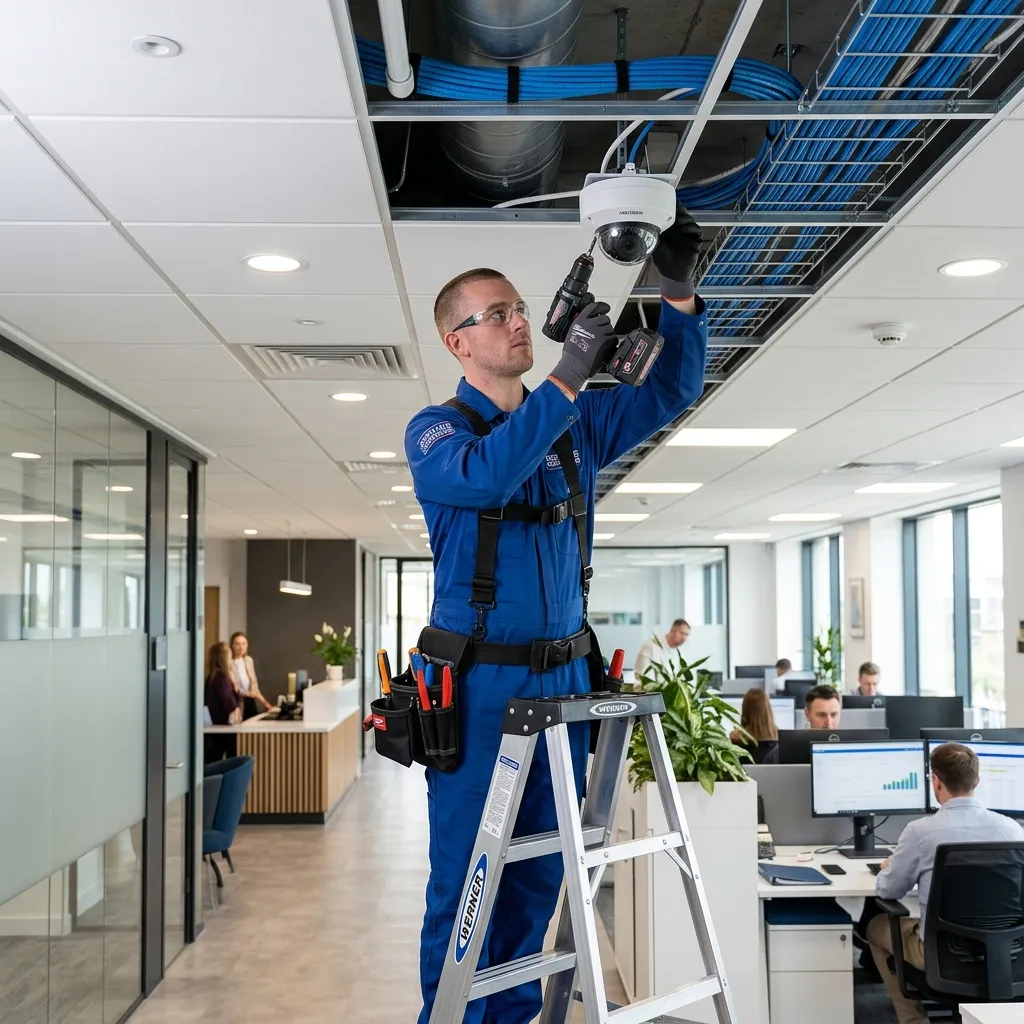
Short answer: Most commercial premises in Ras Al Khaimah must have a CCTV system built to the official Technical & Security Requirements & Specifications for HEMAYA System (Version 4.1), installed and maintained by a GRA-approved provider. Recordings must be kept for at least 90 days (30 days for buildings under construction), cameras must be full-colour with WDR and at least 1080p, the system needs a UPS of at least 30 minutes, the facility owner must sign an annual maintenance contract, and the premises must hold a valid Hemaya certificate — often needed to issue or renew a trade licence.
This guide explains who has to comply, what Version 4.1 of the Hemaya specification actually requires, how approval works step by step, and the mistakes that most often hold businesses up. It is written from the installer's side: RADON COMPUTER is a GRA-approved CCTV integrator based in Al Nakheel, listed on the official GRA list of approved integrators.
What GRA and Hemaya are
CCTV in Ras Al Khaimah is governed by RAK Law No. 3 of 2015 on Technical Systems for Establishments Security, as amended by Law No. 6 of 2021. The technical rules are set out in the Hemaya System specification, Version 4.1, published by the General Resources Authority (official PDF).
- RAK Police set the security requirements through the Hemaya system.
- The General Resources Authority (GRA) supervises approvals, maintains the list of approved service providers, and oversees compliance.
These rules are specific to Ras Al Khaimah. Dubai premises fall under SIRA and Sharjah premises under Sharjah Police — a RAK Hemaya approval does not carry over to another emirate.
Which category is your facility? (Version 4.1)
Version 4.1 classifies facilities into seven categories by activity and security importance. The category decides your technical requirements.
| Category | Examples from the specification |
|---|---|
| 1 Public / government | Ministries and government buildings, ports and border crossings, government hospitals, schools and universities, clubs, utilities |
| 2 Critical | Banks, exchange houses, jewellery and precious metals, hazardous chemicals, ATMs |
| 3 Large commercial / industrial | Large malls, hotels 3★ and above, fuel stations, large factories, large private schools and hospitals |
| 4 Medium commercial / industrial | Shopping centres with 10+ units or 6+ doors, hotels under 3★, private clinics and pharmacies, supermarkets with 6+ doors, towers and residential complexes, labour accommodation, mosques, wedding halls |
| 5 Small commercial | Restaurants, groceries, small supermarkets (under 6 doors), mobile phone shops, laundries, small retail outlets and similar |
| 6 Special nature | Women's salons, fitness centres and clinics, women's tailoring, massage shops, military equipment retail |
| 7 Under construction | Buildings under construction |
If you are not sure which category applies — or whether a private villa, farm or home business is in scope — ask GRA before buying equipment.
The core requirements
| Requirement | What Version 4.1 requires |
|---|---|
| Certificate | The premises must hold a valid Hemaya certificate, often needed to issue or renew a trade licence. |
| Approved provider | Installation and maintenance by a provider approved by RAK Police and GRA. |
| Retention | Continuous recording for at least 90 days; 30 days for buildings under construction. |
| Recording | Password-protected recorders, accurate date and time stamps, search by date, time and camera, automatic restart after a power failure, recording from at least 10 seconds before an alarm, USB export that keeps the original time stamp. |
| Backup power | A UPS for at least 30 minutes (categories 1–6). |
| Maintenance | The facility owner must sign an annual maintenance contract; the provider must respond promptly to faults. |
| Wireless | Wireless cameras are prohibited, and wireless video transmission or live streaming is not permitted without authorisation from the competent authority. |
| Phone access | Among operating businesses, connecting cameras to mobile devices is allowed only for Category 5, with approval — never for Category 6. Construction sites (Category 7) use secure 4G remote access as the specification requires. |
| Signage and access | A clear notice that CCTV is operating; viewing limited to authorised persons; footage supplied to RAK Police on official request. |
| Drawings | An AutoCAD layout of internal and external cameras, numbered from the outside in, on an A4 landscape plan with the facility's coordinates. |
Key technical specifications (Version 4.1)
| Item | Requirement | Applies to |
|---|---|---|
| Camera resolution | At least 1080p | Categories 1–6 (3MP for Category 7) |
| Entrance cameras | Fixed cameras of at least 4MP at public entrances and exits | Categories 1–4 |
| Entrance camera height | No higher than 2.5 m from the ground | Categories 1–6 |
| Colour and lighting | Full-colour day and night, without relying on infrared | All |
| WDR | WDR cameras; at least two outdoor cameras with true WDR (not DWDR) | All |
| Outdoor rating | IP66 / IP67 | All |
| Compression | H.264 or H.265 | All |
| Recorder | NVR or VMS, 15 fps at 1080p per channel | Categories 1–4 |
| Recorder | DVR allowed, at least 10 fps during working hours | Categories 5–6 |
| Audio | Audio recording at customer-service counters and cashier areas | Categories 1–6 |
| Number plates | ANPR cameras; parking and road cameras must capture plates day and night | Categories 1–4 |
| Face recognition | Required in categories 1–2, and in some 3–4 facilities on security recommendation | As stated |
| Cabling | Concealed, numbered at both ends; GI or steel flexible conduit outdoors, PVC indoors; weatherproof, UV-resistant CAT6 outdoors | All |
| Monitor | At least 1080p, dedicated to CCTV | All |
Where cameras must go — and where they must not
Areas requiring coverage under Version 4.1: public entrances and exits (inside and outside), customer service counters, vehicle entrances and exits, waiting areas and corridors, parking areas, elevators and staircases, kitchens, emergency exits, control rooms, safes, storage and archive rooms, electrical room entrances, gas cylinder storage and building rooftops. Your approved design defines the exact positions for your premises.
Not allowed: cameras in female-only areas, bedrooms, physiotherapy rooms, changing rooms and similar private areas, as well as toilets and bathrooms. Cameras must not monitor areas outside your boundaries or third-party property without authorisation, and hidden cameras need prior written approval. Breaching privacy rules carries a penalty and will fail inspection.
Recording, retention and storage
The 90-day minimum is about real recorded footage, not the recorder's advertised capacity. Storage has to be sized so the full retention period is genuinely covered at the resolution and frame rate you actually record. A recorder whose disks fill up and start overwriting before day 90 is non-compliant.
If a hard drive has to be replaced, a change request is submitted through the Hemaya system and the facility owner keeps the old drive for 90 days under a signed commitment letter. Before using any cloud service, check with GRA: recordings must not be transferred, stored externally or shared with an unlicensed party without approval.
The approval process, step by step
| Step | What happens | What you have at the end |
|---|---|---|
| 1. Choose an approved integrator | Confirm the provider is on the current GRA list. | A provider who can legally submit and install. |
| 2. Confirm your category | Categories 1–7 have different requirements. | The specification that applies. |
| 3. Survey and design | Site survey, AutoCAD camera layout, camera schedule, storage calculation, Bill of Quantities. | A design ready for submission. |
| 4. Submission | Through the GRA Hemaya system. | Approval of the design. |
| 5. Installation | Only the approved design and equipment are installed. | A system that matches the approved drawings. |
| 6. Inspection and certification | Image quality, recording and retention are demonstrated. | Your Hemaya certificate. |
| 7. Maintenance and renewal | Annual maintenance contract, technical support log, records. | A file ready for renewal. |
Approval timelines are set by the authority, not by the installer — so start early.
Why systems fail inspection
- The installation does not match the approved design — a camera moved, a model substituted, a camera added.
- Storage cannot hold the full retention period.
- Faces at the entrance are not identifiable — usually a camera facing bright glass without true WDR, or mounted above 2.5 m.
- Infrared-only night images instead of full-colour.
- No UPS, or a UPS that cannot run for 30 minutes.
- Missing signage, records or maintenance contract.
- A camera or disk has failed and nobody noticed, breaking continuous recording.
Certificate expiry and renewal
An expired Hemaya certificate is typically the first thing that blocks a business's other government renewals: the trade licence and related services cannot be renewed while it is lapsed.
A grace period of 30 days from the date of expiry generally applies, but it is subject to approval and is not automatic. Staying inside that window does not avoid a penalty. The only safe approach is to renew before the expiry date, starting at least a month ahead and auditing the system first. Your mandatory CCTV maintenance contract keeps the records renewal needs. See also our Hemaya compliance checklist.
Construction sites (Category 7)
Sites under construction must be covered from the beginning of works and throughout the build. Version 4.1 sets 30 days of retention for this category, and requires:
- Enough cameras to cover all angles of the site, mounted on reinforced steel poles fixed on an 80 cm-deep concrete base, at a height of 2.80 m on the outer sides, with alert sensors
- Cameras that capture vehicle plate numbers and identify people day and night
- Solar-powered cameras with adequate panels, inverter and battery backup
- 4G connectivity for remote access with secure SIM/APN settings and encrypted (SSL/VPN) transmission
- Construction materials kept within camera view, and respect for neighbouring residents' privacy
The obligation falls on the contractor, not the landowner. See construction site CCTV in RAK.
What a compliant system costs
As an indicative starting point, not a quotation:
| System | Indicative range |
|---|---|
| Basic 4-camera system, small shop | From AED 1,500 – 2,500 |
| GRA-approved 8–16 camera system, warehouse or hotel | AED 4,000 – 12,000+ |
The real figure depends on your category, camera count, resolution, retention and site conditions. Government fees and civil or electrical works are separate. See how much CCTV installation costs in RAK.
How to check an installer is genuinely approved
Ask the provider for their current approval, then check the official GRA list of approved integrators or contact GRA on +971 7 235 7779 or [email protected]. RADON COMPUTER is listed there.
Frequently asked questions
Does a small shop in Ras Al Khaimah need GRA-approved CCTV?
Most commercial establishments do. Small shops, restaurants and groceries usually fall under Category 5 of the Hemaya specification. Confirm your category with GRA or an approved integrator before buying equipment.
How long must CCTV recordings be kept in RAK?
At least 90 days of continuous recording, and 30 days for buildings under construction.
Can I watch my business cameras on my phone?
Among operating businesses, only Category 5 facilities may connect their cameras to mobile devices, and only with approval; Category 6 facilities may not. Construction sites (Category 7) use secure 4G remote access as the specification requires. Ask your integrator which category applies to you.
Can I add a Wi-Fi camera to my approved system?
No. Version 4.1 prohibits wireless cameras and does not permit supplementary systems in facilities covered by the Hemaya system.
Is an annual maintenance contract required?
Yes. Version 4.1 requires the facility owner to sign an annual maintenance contract to keep the system running and secure.
What happens if my Hemaya certificate expires?
Your trade licence and related renewals can be blocked. A 30-day grace period generally applies but needs approval and does not avoid a penalty — renew before the expiry date.
Official sources
- Technical & Security Requirements & Specifications for HEMAYA System, Version 4.1 (PDF): gra.rak.ae/Content/e_4.1.pdf
- List of approved integrators — GRA Hemaya portal: gra.rak.ae/Hemaya
- GRA Protection & Security Systems Regulation Guide (PDF): gra.rak.ae/Content/protection__en.pdf
- GRA: +971 7 235 7779 · [email protected]
This guide summarises RAK Law No. 3 of 2015 as amended by Law No. 6 of 2021 and the Hemaya System specification Version 4.1. It is general information, not legal advice. Requirements change — always confirm the current rules for your premises with GRA.
Note: RADON COMPUTER follows the rules and regulations of the Government of Ras Al Khaimah's General Resources Authority (GRA). This guide is general information. For further details and clarifications, please contact the authority directly at gra.rak.ae.
Get it right the first time
RADON COMPUTER handles the whole process — survey, design, submission, installation, inspection, maintenance and renewal — as a GRA-approved CCTV integrator. Site surveys are free anywhere in Ras Al Khaimah. Book a free inspection or message us on WhatsApp at +971 56 566 5529.